









Japanese Prime Minister Sanae Takaichi said the death toll from the powerful earthquake that struck Kumamoto Prefecture had risen to 13, including deaths that are still being investigated to determine whether they were related to the 7.1-magnitude tremor, public broadcaster NHK reported Wednesday.
An earthquake with a magnitude of 7.1 jolted southwestern Japan on Tuesday, injuring dozens as authorities scrambled to assess the extent of the damage amid reports of collapsed buildings, fires, power outages and traffic disruptions.
The temblor registered a maximum 7 on the Japanese seismic intensity scale in parts of Kumamoto Prefecture, which was hit by similarly powerful quakes a decade ago. At that level, people cannot remain standing or move without crawling and may be thrown through the air, according to the Japan Meteorological Agency.
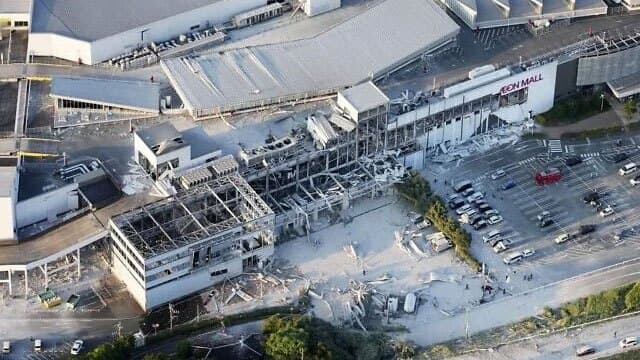
Following the 4:27 p.m. quake, an explosion occurred at an Aeon Co.-operated shopping mall in Kashima, Kumamoto Prefecture. It is feared that many people remain trapped, with 10 unaccounted for after the building's second floor collapsed, according to local authorities.
The explosion happened after about 200 people evacuated, but multiple people were seen returning to the building, according to the police and a shopper who evacuated. Self-Defense Forces personnel engaged in rescue efforts at the site.
In Yatsushiro in the same prefecture, a smokestack broke and fell over at a plant operated by Nippon Paper Industries Co. At the papermill, two people were found unresponsive, while nine others remained unaccounted for, according to the prefectural government.
One person was confirmed dead after being taken to a hospital from a collapsed house in the coastal city.
A cargo train operated by Japan Freight Railway Co. derailed and overturned at Yatsushiro Station, but the driver was uninjured.
Stone walls of the popular Kumamoto Castle, which was damaged by the previous quakes in 2016, also crumbled.
Local firefighting authorities have received reports of people trapped inside their homes in Kumamoto city. A hospital in Kumamoto said it took in around 50 injured people.
"It shook vertically and sideways for about 10 to 20 seconds. It was worse than during the Kumamoto earthquake (in 2016)," said an 89-year-old man in Uki, one of the hardest-hit cities.
Power outages have affected about 48,000 households in the southwestern prefecture, while 140,000 households were without water.
No abnormalities were reported at the Sendai nuclear power plant in neighboring Kagoshima Prefecture or at the Genkai nuclear power plant in Saga Prefecture to the northwest, according to Kyushu Electric Power Co.
Tsunami advisories were issued for the nearby Ariake and Yatsushiro seas after the quake but were later lifted.
The quake occurred at a depth of around 16 kilometers. The maximum 7 on the seismic intensity scale was registered in Kumamoto's Uki and Kikawa, and upper 6 in surrounding areas.
The intensity of 7 was registered for the first time since January 2024, when a powerful quake struck the Noto Peninsula in central Japan.
Upper 5 was registered in neighboring Kagoshima Prefecture and lower 5 in Fukuoka and Saga prefectures. Aftershocks of similar intensity were subsequently felt in the area.
"We will make every effort to carry out emergency disaster response measures, with rescue and lifesaving operations led by local police and fire departments as our top priority," Prime Minister Sanae Takaichi said at a press conference.
The weather agency urged people to remain alert for quakes of similar intensity over the next few days and warned of heatstroke as temperatures in Kumamoto are expected to reach 35 C or higher.
– with Agencies inputs --