







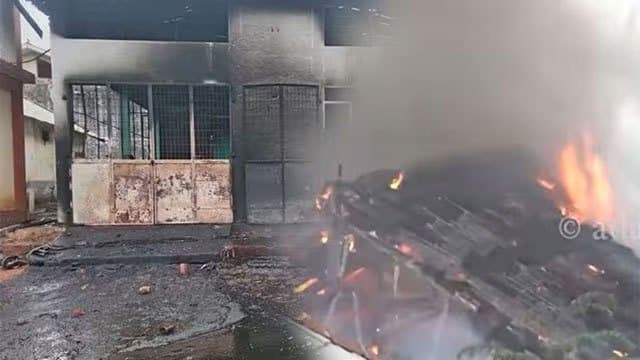



Property damage caused by recent unrest at the Negombo, Mahara, Magazine, Pallansena and Kuruwita prisons has exceeded Rs. 255 million.
The revelation was made during a meeting of the “A Nation United” (Ratama Ekata) National Steering Council held at the Presidential Secretariat today (10), under the chairmanship of President Anura Kumara Dissanayake.
The meeting also discussed increasing access to psychiatric services to help reduce unruly behaviour among prison inmates, according to the President’s Media Division.
President Dissanayake instructed officials to expedite the submission of the draft amendment to the Rehabilitation Act No. 54 of 2007 to Parliament.
He also directed that experienced retired officers be recruited on a contractual basis to overcome delays at the Legal Draftsman’s Department and expedite its work.
The meeting further reviewed the progress of the “Mituru Pasala” programme, jointly implemented by the Ministries of Education and Health to prevent the spread of drugs within the school system.
It was noted that special attention is being given to students’ personality development, while teachers, principals and counsellors are being trained to identify children who use drugs and provide appropriate guidance.
The President instructed officials to implement special programmes targeting schools in areas with a high risk of drug use and high population density.
The Council was also informed of an increasing trend in the spread of dangerous drugs among children attending international schools, the PMD stated.
The possibility of making drug-testing kits available through pharmacies for parents to privately check whether their children are using drugs was also discussed.
Attention was further drawn to groups promoting drugs through the internet and social media, while the possibility of using social media to promote anti-drug attitudes was also considered, the PMD added.
The meeting reviewed progress under the revised Multisectoral National Strategic Plan, which covers six areas: prevention of drug use, early identification, rehabilitation, legal and institutional reforms, prevention of relapse and follow-up, and planning, regulation, review and reporting.