






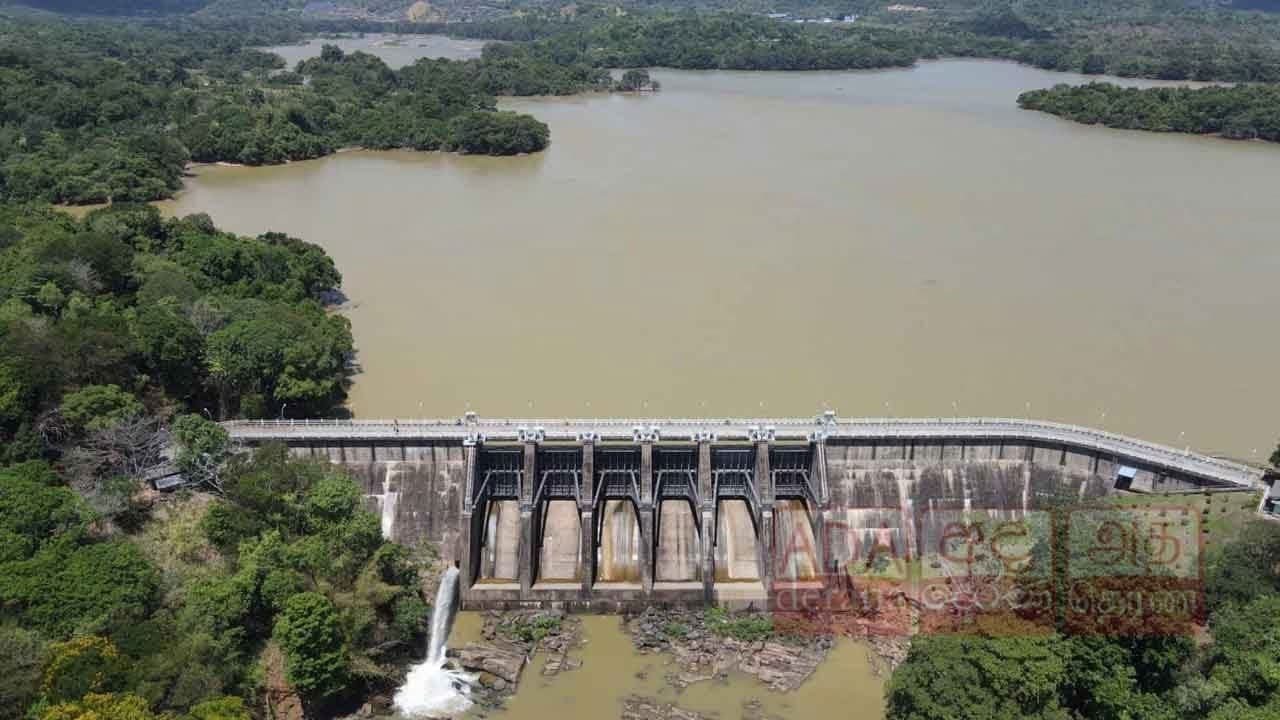



The Bowatenna Reservoir, a key water source supplying the Kala Wewa basin, will be completely drained from August 24 to facilitate essential repair and maintenance work, authorities said.
Reservoir Engineer Buddhika Mahesh Nawaratne said the upcoming operation will be the first full-scale maintenance of the reservoir since its construction around 50 years ago.
The decision has been taken mainly due to the significant accumulation of sediment, which has substantially reduced the reservoir’s water storage capacity.
Bowatenna Reservoir was originally designed to hold around 56 million cubic metres of water. However, a survey conducted in 2014 found that its capacity had fallen to approximately 23 million cubic metres due to sedimentation.
Officials said sediment has also accumulated in the tunnel supplying water to Kala Wewa and near the power generation facility, affecting the release of the required 1,000 cubic feet of water per second to the Kala Wewa basin.
The maintenance programme has been scheduled during the current dry weather conditions. The reservoir’s water level has already declined, with the available water volume currently estimated at around 11 million cubic metres.
Water released from the reservoir has been stored in the Kandalama, Kala Wewa and Ibbankatuwa reservoirs. Following the three-week maintenance programme, Bowatenna is scheduled to begin refilling from September 14.
The water required for refilling the reservoir has been reserved at the Kotmale Reservoir, officials said.
The maintenance work will be carried out using machinery under the supervision of the Mahaweli Authority, at an estimated cost of around Rs. 4 million.
Meanwhile, measures have been taken to maintain a continuous flow of 1,000 cubic feet of water per second through the Polgolla Dam, Sudu Ganga and the Amban Ganga towards the Moragahakanda Reservoir during the maintenance period.
Authorities said the measure is intended to protect the aquatic ecosystem, including fish populations in the Amban Ganga.
The reservoir engineer has urged the general public not to enter the drained reservoir bed for fishing or sightseeing, warning that the sediment accumulated over five decades could pose safety risks.
Once the maintenance work is completed, the reservoir is expected to regain increased storage capacity and provide water to the Kala Wewa basin more efficiently.