





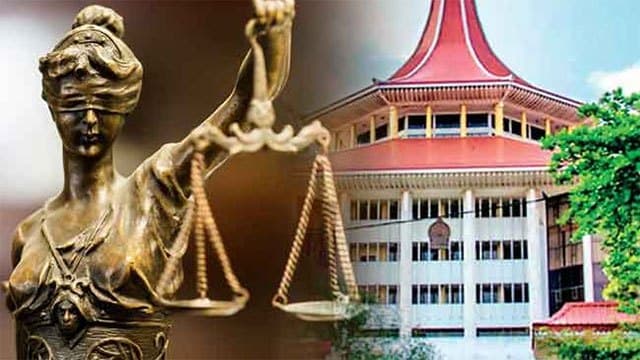



A total of 21 petitions have been filed before the Supreme Court challenging the government’s proposed 22nd Amendment to the Constitution, with the petitioners arguing that the Bill could affect public sovereignty and the independence of the judiciary.
The latest petitions were filed by a group including the Treasurer of the Vinivida Foundation Sunil Jayasundara, Dr. Ajantha Perera, Attorney-at-Law Shiral Lakthilaka and the Young Lawyers’ Association, said Ada Derana reporter.
Earlier, petitions challenging the constitutionality of the Bill were filed by the Bar Association of Sri Lanka (BASL), former Minister Prof. G. L. Peiris, Prof. Ranjan Abeyratne and several others.
The proposed amendment has become the subject of legal and political debate following its presentation to parliament by the government.
Among the key proposed changes are provisions relating to the retirement ages of judges of the superior courts. The Bill proposes to increase the retirement age of Supreme Court judges from 65 to 67 and that of Court of Appeal judges from 63 to 65.
The government has maintained that the proposed reforms are aimed at strengthening the judicial system and improving its efficiency, including addressing delays and the backlog of cases.
However, the petitioners have raised concerns over the constitutional implications of the proposed changes, particularly in relation to judicial independence and the exercise of the judicial power of the people.
Some petitioners have also challenged the application of the proposed retirement-age changes to serving judges, arguing that such provisions could have an impact on the independence of the judiciary and the separation of powers.
The petitioners are asking the Supreme Court to determine that the Bill is inconsistent with the Constitution and cannot be enacted through Parliament alone.
They have accordingly requested the Court to rule that the Bill must receive approval at a public referendum, in addition to securing the constitutionally required parliamentary majority, before it can become law.
Under Sri Lanka’s Constitution, the Supreme Court has jurisdiction to determine whether a Bill is inconsistent with the Constitution when a petition challenging its constitutionality is filed within the prescribed period following its presentation to parliament.
The Supreme Court’s determination will therefore be crucial in establishing whether the proposed 22nd Amendment can proceed through the ordinary parliamentary process or whether a referendum would be required.