






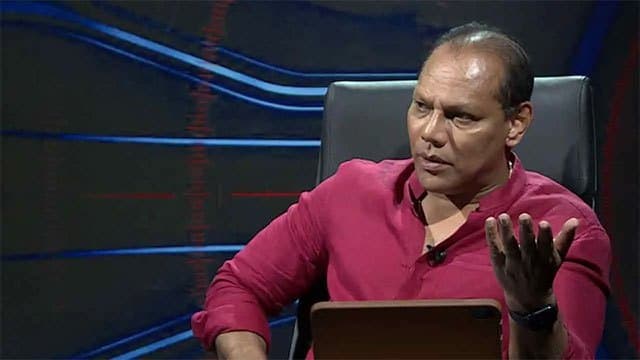


Samagi Jana Balawegaya (SJB) Parliamentarian, Attorney-at-Law Dayasiri Jayasekara has called for the immediate resignation of the Speaker of Parliament, claiming that an investigation is currently being conducted against him by the Commission to Investigate Allegations of Bribery or Corruption (CIABOC).
Jayasekara made these remarks while speaking in the “360°” programme aired on TV Derana last night (14).
The MP said he had raised the matter in Parliament as a privilege issue under Standing Order 29, claiming that the CIABOC is currently conducting an investigation against the Speaker under file number BC/0356/20/26 B 206.
He further referred to Section 107(2) of the Anti-Corruption Act, which, he said, prohibits a public official or public authority from participating in or voting on a matter in which the official has a direct or indirect interest.
According to Jayasekara, a violation of this provision could result in a fine of up to Rs. 1 million or imprisonment with rigorous imprisonment for a period of up to seven years.
He alleged that, despite the ongoing investigation, the Speaker had presented the CIABOC’s annual budget to Parliament on September 8, which he claimed was contrary to the law.
Jayasekara also argued that a conflict of interest arises from the Speaker’s role as a member of the Constitutional Council, which recommends the appointment of the Chairman and other members of CIABOC.
He further pointed out that amendments to the law relating to CIABOC are currently before the Supreme Court and that, once the relevant Bill is passed by Parliament, the Speaker would be required to place his signature on it under Article 79 of the Constitution.
Explaining his position, Jayasekara said the provisions of the Anti-Corruption Act clearly restrict an individual under investigation from becoming involved in matters concerning the commission.
“The most important matter is Section 107. Where a public official or public authority has a direct or indirect interest in a decision, that official should not vote on or participate in any activity related to that decision,” he said.
He claimed that Section 107(2) specifically prevents a person under investigation from becoming involved in matters connected to CIABOC, adding that Section 107(3) provides for a fine of up to Rs. 1 million or a prison term of up to seven years for such an offence.
Jayasekara also questioned the Speaker’s presentation of CIABOC’s annual budget in Parliament on September 8.
“A person who has a complaint against him and is currently under investigation cannot legally present this. If an investigation is conducted into this, he could face a fine of Rs. 1 million or seven years’ imprisonment,” he claimed.
He further alleged that the Speaker’s participation in the Constitutional Council in matters concerning the appointment of CIABOC members while an investigation is allegedly being conducted against him would also constitute a conflict of interest.
Turning to the proposed amendments to the CIABOC Act, Jayasekara said the Supreme Court is expected to deliver its determination on the Bill in the coming parliamentary week.
He argued that, following the parliamentary debate and passage of the Bill, the Speaker would be required to sign it under Article 79 of the Constitution, creating a further legal issue given the alleged investigation.
“Under the circumstances, he cannot sit in the House or sign the Bill. This is being pushed into a completely unlawful situation,” Jayasekara said.
He therefore maintained that the Speaker has no option other than to resign.
“I say that he should resign. Other than resigning, there is no alternative for him,” he said.
However, Jayasekara stressed that he was not declaring the Speaker guilty, noting that the matter remains at the investigation stage.
“I am not saying this because I consider him guilty. The matter is still at the investigation stage. I am not saying that he is guilty. My argument is that, given the existing legal circumstances, he cannot remain in that position,” he said.