




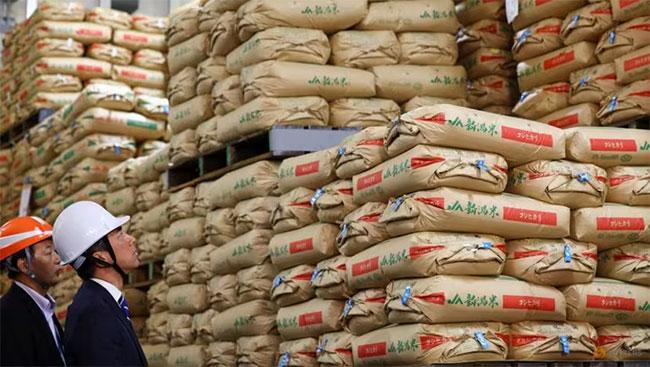



Japan is grappling with rice shortages and price hikes, forcing it to ramp up imports.
Just across the sea, South Korea is facing the opposite problem — an overwhelming surplus that has driven prices so low, some regions are practically giving rice away.
As shortages and surpluses hit wallets and livelihoods, the instability of rice supply could have an impact far beyond the dining table, said observers.
TACKLING OVERSUPPLY
Farmer Park Geun Sik spent his life working the land in Haenam, a farming town in South Jeolla province, about 330km south of Seoul.
When he started, everything from planting seedlings to threshing rice was done by hand. Rice was so scarce that there were designated no-rice days banning its sale.
Then, machines arrived and high-yield rice varieties were introduced as South Korea embarked on a drive for self-sufficiency.
Like most farmers in South Korea, Park is a member of the National Agricultural Cooperative Federation Nonghyup.
Nonghyup buys rice directly from farmers, then handles everything from drying and storing it to packaging and distribution.
“There is never a year when we can’t sell the harvested rice,” Park told CNA. “Most co-op members find it more convenient that way.”
Every year, the South Korean government imports and also purchases rice from farmers to ensure food security.
It also buys “quarantine rice”, which is the supply it wants to take off the market in order to stabilise prices.
The government purchased 1.2 million tonnes of rice from 2021 to 2024, according to official data. This amounts to about US$1.9 billion worth of rice sitting in government storage.
Haenam County Office said the government stores about 17 to 18 per cent of annual rice consumption in case of disaster or war. That is around 700,000 to 800,000 tonnes.
Kim Ung Il, an officer with the office’s distribution support division, said older reserves are usually sold to manufacturers of processed food, and recent harvests to low-income families, for as little as US$2 for a 10kg pack.
For rice released for retail, the price fluctuates based on factors such as harvest yields.
Korean farmers frustrated by thinning margins have taken to the streets to demand change.
Gu Gwang Seok, executive director of the non-profit Korean Peasants League (Gwangju), said rice prices have barely risen in the 30 years he has been farming, blaming imports for pushing down prices.
“Every year, we import about 13 per cent of our domestic rice production. In terms of volume, that’s around 408,000 tonnes (required under World Trade Organization agreements),” he added.
“That is why farmers are protesting. They are demanding that the government guarantee the price of rice and stop importing it.”
Meanwhile, the door to exporting rice has never really opened. Most countries do not favour the short-grain, sticky Japonica rice South Korea produces except Japan.
DEALING WITH SHORTAGE
In April, Japan bought Korean rice for the first time since 1999 when it was facing a rice shortage.
Rural Japanese families traditionally get their rice at negotiated prices from a local dealer or directly from farmers.
At supermarkets across Japan, rice is selling at record prices or simply out of stock.
Rice prices doubled from a year ago in May this year. In July, it’s about US$27 on average for a 5kg pack, prompting the government to release emergency reserves.
But the sales are massively depleting stockpiles, with only about 100,000 tonnes of rice left.
Japan imports 770,000 tonnes of rice a year under WTO rules. Anything more brought in by the private sector incurs hefty tariffs of about US$2.30 per kilogram.
But as domestic rice prices soar, private sector imports are rising. In May, they amounted to some 10,600 tonnes - mostly from the United States - up from just 115 tonnes a year ago.
Kazuyoshi Fujimoto owns a 15-hectare rice farm in Kakogawa city - passed down for generations - but began shifting away from growing rice two years ago due to high costs.
“To tend to paddy fields, you need to invest in machinery,” he said. “If it malfunctions, it costs 5 million to 6 million yen (US$33,700 to US$40,400) to replace it. So eventually, I plan to move entirely from paddy fields to growing figs.”
Japan began paying farmers to reduce rice acreage in the 1970s to tackle overproduction and keep rice prices high.
Now, production targets are still set by the government and influenced by Japan Agricultural Cooperatives (JA) which nearly all farmers belong to.
Around 70 per cent of crops harvested are sold through JA, according to experts, and the rest to wholesalers, retailers or straight to consumers.
It sent Fujimoto a flyer offering to buy his rice for at least 11,500 yen (US$77.50) for every 30kg this year, which is about twice as much as last year.
“Until three years ago, prices (paid by JA) were stable,” said Fujimoto. “But in the past year or two, prices rose a little, by 30 per cent. Then this year, it was a big hike.”
Rice production has tumbled over the years, from a peak of 14.45 million tonnes in 1967 to less than 7 million tonnes last year.
Farmers told CNA they were puzzled by the sudden severe shortage, with some pointing to the complexity of the supply chain.
In Nagano, known for its mountainous terrain and high-quality rice, some farmers said middlemen are paying three times more for their rice compared to last year.
Poor harvests caused by heatwaves and a spike in inbound tourism are being cited as factors for the shortage. Japan’s farming population, too, is steadily shrinking.
Analysts said it is critical to stop reducing rice acreage and consolidate small-scale farms by encouraging their owners - who are mostly elderly - to lease their land to larger operations.
“Full-time farmers will be richer by accumulating more land. They could improve the efficiency of rice production,” said Kazuhito Yamashita, research director at the think tank Canon Institute for Global Studies.
“But it is not easy to implement in Japanese politics because we have to face politically powerful agricultural cooperatives.”
LOOKING FOR ALTERNATIVES
Meanwhile, South Korea’s growers are watching closely.
In Haenam, conditions are ripe to adapt rice fields for other crops. Farmers like Kim Jun Hyeong get government incentives to switch from rice to beans.
“In the case of rice farming, you usually have to grow the seedlings for about 20 days before transplanting. But when there is no need for that process (such as when growing beans), it becomes more advantageous,” he said.
“For beans, they go for about 4,000 to 4,500 won (US$2.90 to US$3.30) per kilogram,” he added. “Rice, on the other hand, doesn’t even fetch 2,000 won per kilogram.”
Kim now sets aside half his farmland for beans. His income has almost doubled, propelled by the incentives.
In cities like Seoul, rice is finding a second life.
Rike Bakery, which opened a few months ago, sets itself apart by using rice flour — a pricier alternative to wheat flour — as its key ingredient.
The government is also promoting it as a substitute to raise rice consumption.
“I think rice has a better image than wheat,” said Jeon Hee Ju, owner of Rike Bakery.
“So when customers hear it’s made from rice, they feel it’s healthier and more comforting to eat.”
Source: CNA
- Agencies