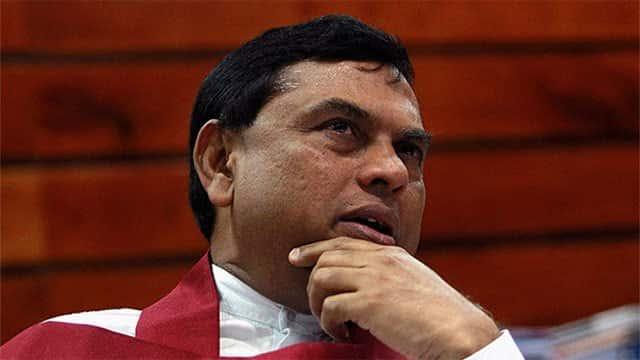











Former President Mahinda Rajapaksa says that the policy on which the proposed new Inland Revenue law is based, is in keeping with the ideology of the UNP but is contrary to that of the SLFP.
Issuing a statement today (21), he said that no member of the SLFP can pass legislation that seeks to tax provident fund contributions, to tax individuals more and companies in the same industry less, to increase the tax burden on the struggling middle class, and to tax places of worship.
He stated that this new law is weighted against local production, local entrepreneurship, local creativity and local people and favours multinationals and foreigners.
“I wish to remind all SLFP parliamentarians serving in the government that even though the President was elected to power largely on UNP votes, that all SLFP parliamentarians were elected to parliament by SLFP/UPFA voters in a campaign led by me.”
Therefore, all MPs of the SLFP are duty bound to vote against this Bill when it comes up in Parliament, Rajapaksa said.
A Bill to replace the Inland Revenue Act No: 10 of 2006, is to be taken up in Parliament on Friday (25). In his statement he gave the following reasons as to why they oppose this Inland Revenue Bill.
1. Under Clause 5(2)(f) of the Bill, the employer’s contribution to a provident fund will be considered a part of an employee’s taxable income. This will make EPF payments a burden to employees. Under Item 8 of its First Schedule, the tax on income generated by provident funds through their investments will increase from the present 10% to 14% thus reducing the income available to fund members.
2. The tax exemption granted to all places of worship has been dropped in the proposed law and Item 6 of the First Schedule has fixed the tax for such charitable institutions at 14%. According to the Third and Fifth Schedules, places of worship and charitable institutions will be eligible for a tax concession only if the money is used to provide care to children, the elderly or the disabled. The incomes of some places of worship are supervised by the government and such institutions will be taxed to the maximum whereas other places of worship not supervised by the government will be able to escape the tax net. Such discriminatory practices will give rise to social tensions.
3. Furthermore, the existing 2006 Inland Revenue Act provides concessions through Chapter III on tax exemptions to various fields deemed worthy of preservation such as local handicraft industries, film and drama producers etc. This Chapter also has concessions for various economic activities such as new undertakings in pharmaceuticals, renewable energy, production for import substitution etc. There are over 200 such exemptions in the present law. All those concessions are to be removed by the proposed new law.
4. Independent professionals are at present taxed at flat rates for incomes above the tax free threshold of Rs. 500,000, at 12% for up to Rs. 25 million a year, going up to 16% for anything above 35 million. Under the proposed law, professionals will be taxed at the rates applicable to individuals - tax free for the first Rs. 600,000 and for each succeeding Rs. 600,000 at rates starting at 4% and increasing gradually to 8%, 12%, 16%,20% with the maximum rate of 24% applying to any income above Rs. three million a year. The income tax for professionals had been kept low so as to encourage them to remain in Sri Lanka without moving overseas.
5. Under Item 10(b)(iii) of Schedule One, rental income will be subject to a 10% withholding tax. This will cause immense hardship to middle class people trying to supplement their income by renting out properties.
6. Under the First Schedule of the Bill, the maximum rate of tax applicable to individuals will be 24%. Though the maximum rate applicable to companies is 28%, in certain specified fields such as education, agriculture, tourism, IT based services and exports, the applicable rate will be 14% regardless of the size of the enterprise. This will result in anomalous situations where a large company providing educational services may be taxed at 14% while a teacher who gives private tuition in his home will be taxed at 24%; a major agricultural company will be taxed at 14% while an enterprising youth engaging in market oriented agriculture will be taxed at 24%. The tax on the small and medium sector is also to go up from the present 12%, to 14% under the new law.
7. Under the 2006 Inland Revenue Act, and the Acts that preceded it, the law had conferred power directly on the Assessors and Assistant Commissioners of the Inland Revenue Department. However under Clauses 97 and 98 of this Bill, all power is concentrated in the hands of the Commissioner General who may delegate his powers to individual officers entirely at his discretion. The Commissioner General of Inland Revenue is appointed by cabinet and functions under the Finance Minister. Under Clause 100, the Minister will have access to confidential information on tax files. The concentration of all power in the hands of the Commissioner General will give rise to a situation where politicians are able to stage manage the tax assessments that are served on individuals. The conferring of powers directly on the officers of the Inland Revenue Dept. was a safeguard to prevent the concentration of power. When power is vested in the Assessors and Assistant Commissioners, it is more difficult to misuse ministerial power to obtain confidential information on individual cases.
8. At present, there are several dispute resolution mechanisms in the Inland Revenue Department. A party that is not in agreement with a tax assessment will first be given a hearing by another Assessor. If unresolved, the grievance will be heard by a higher official. At the next stage, the Commissioner General will appoint a senior official to go into the matter. After this an appeal can be addressed to the Tax Appeals Commission which is an independent body outside the IRD. The final recourse for an aggrieved party would be the courts. This system will work only when the law confers power directly on the Assessors or Assistant Commissioners. When all power is concentrated in the hands of the Commissioner General, there will be little point in having appeals heard against the Commissioner General by other officers under him. Hence if the new law is passed, some taxpayers may have no option but to go directly to either the Tax Appeals Commission or the Courts.