






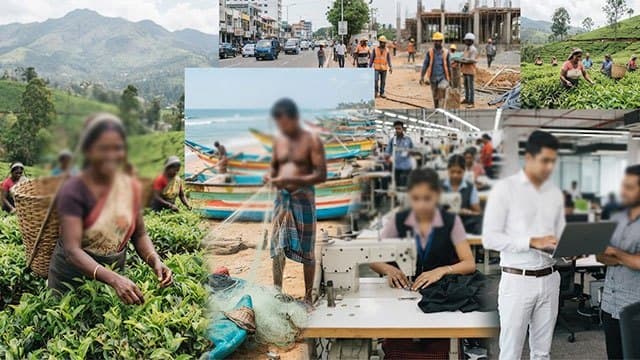


Sri Lanka’s employed population has exceeded 8 million in the year 2025, according to the latest report released by the Department of Census and Statistics.
According to the report, the employed population stood at 8,079,040 in 2025, comprising 5,299,777 males and 2,779,262 females.
The overall employment rate in the country was recorded at 96.1%, the report stated.
The population aged 15 years and above was estimated at 17,034,109 in 2025, of whom 8,408,251 were in the labour force. Accordingly, the labour force participation rate was recorded at 49.4%.
The male labour force participation rate stood at 69.1%, while the rate among females was 32.4%.
Meanwhile, 6,185,730 females aged 15 years and above were outside the labour force, according to the report.
The total population outside the labour force stood at 8,625,859, of whom 71.7% were females, amounting to nearly 6.2 million.
The women outside the labour force include those engaged in household work, education, retired or elderly persons, and those who are not working due to health-related reasons.
Household work was identified as the main reason, accounting for 58.1% of economically inactive females.
A further 17.8% were engaged in education, while 16.0% were retired or elderly and 6.6% were outside the labour force due to illness or disability.
Meanwhile, the total number of unemployed persons in Sri Lanka stood at 329,211 in 2025, with the national unemployment rate recorded at 3.9%, according to the report.
Of this total, 149,931 were males and 179,280 were females. The male unemployment rate was 2.8%, compared to 6.1% among females.
The overall unemployment rate has declined from 4.4% in 2024 to 3.9% in 2025, while the female unemployment rate fell from 7.1% to 6.1% during the same period.
The report also noted that unemployment among young people remained relatively high. The unemployment rate among those aged 15 to 24 was recorded at 19.5%.
The rate stood at 16.5% among young males and 24.5% among young females, while the unemployment rate among females aged 25 to 29 was recorded at 17.1%.
When employment is considered by economic sector, the largest share of workers was employed in the services sector.
A total of 4,026,037 people were employed in the services sector in 2025, accounting for 49.8% of total employment.
The industrial sector accounted for 26.2% of employment, while agriculture accounted for 23.9%.
The report further noted that the share of employment in the services sector increased from 48.5% in 2024 to 49.8% in 2025, while the share of employment in agriculture declined from 26% to 23.9%.
According to wage data, the estimated average gross monthly salary of a monthly-paid employee in 2025 was Rs. 65,325.
The average gross monthly salary was Rs. 70,942 for male employees and Rs. 57,867 for female employees.
Among daily-paid employees, the average monthly earnings were Rs. 41,290 for males and Rs. 22,640 for females.
Meanwhile, 439,839 employed persons, or 5.4% of the employed population, were engaged in a second job in addition to their main occupation.
When both main and secondary jobs are considered, the total number of jobs in 2025 was estimated at 8,518,878.
In addition to labour market data, the report has also revealed information on literacy and digital usage in Sri Lanka.
The literacy rate among the population aged 10 years and above was 93.3% in 2025. The rate stood at 96.3% in urban areas, 93.2% in rural areas and 82.7% in estate areas.
The national computer literacy rate increased to 39.2% in 2025, compared to 35.9% in 2024.
Computer literacy stood at 40.5% among males and 38% among females.
The country’s digital literacy rate was recorded at 72%, while 62.4% of the population aged between 5 and 69 had used the internet in 2025.
Internet usage has also continued to increase, rising from 51.2% in 2023 to 54.6% in 2024 and 62.4% in 2025, according to the report.