







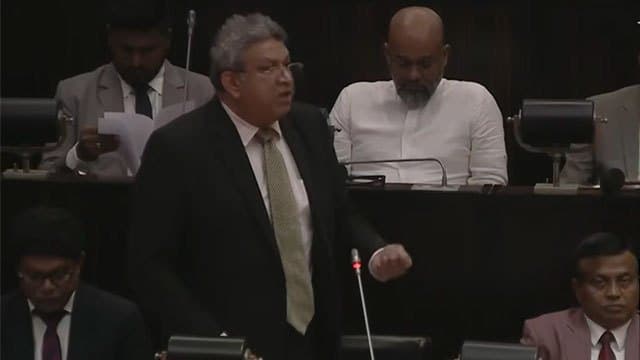


The Minister of Justice and National Integration Minister, Attorney-at-Law Harshana Nanayakkara has stated that the proposed amendments are not intended to establish authoritarianism or suppression, but to hear cases expeditiously and ensure justice and fairness for the people.
Minister Harshana Nanayakkara made these remarks this morning (24) while presenting the 22nd Constitutional Amendment Bill and the Judicature (Amendment) Bill to Parliament for the Second Reading, the Ministry of Justice and National Integration said in a statement.
The Minister further stated:
“Our Government has now completed two years in office. The people are aware that we are a government that acts according to the mandate given by them. Our policy statement, ‘A Wealthy Country – A Beautiful Life’, sets out the fundamental principles upon which the justice and legal systems should operate: equal and fair protection of the law, transparency and efficiency, independence, and public confidence. We made a commitment to the people that the judicial system would be administered based on these principles. These Bills represent one part of fulfilling that commitment.
Hon. Speaker, making the judiciary efficient alone is not sufficient to establish the rule of law. Efficiency must be ensured at several stages of the justice system. The Police and the Criminal Investigation Department must function efficiently. Since assuming office in 2024, we have taken several measures in this regard, including salary increases, allowances, recruitment and other reforms.
If investigations are not conducted efficiently, cases cannot be properly instituted. Once investigations are completed and evidence is compiled, the Attorney General’s Department must examine the material, provide legal advice and institute prosecutions where necessary. However, there are also vacancies within the Attorney General’s Department. These vacancies must be filled, while providing the necessary human resources and technology to improve efficiency. At present, a limited number of officers, including Senior State Counsel and State Counsel, are handling approximately 15,000 to 20,000 cases. This is a matter that must be addressed.
Is that alone sufficient? No. In certain cases, scientific reports are required. For example, when we assumed office, there were 118 vacancies in the Government Analyst’s Department, resulting in delays in Government Analyst reports. We have since taken steps to recruit nearly 70 personnel on both contract and permanent bases to reduce this backlog. These delays had also contributed to overcrowding in prisons. As a result of the measures taken, 9,081 Government Analyst reports were submitted during the previous month.
Why are all these measures being taken? Because the courts can become efficient only when the entire justice-delivery process functions efficiently.
As I have stated on several occasions, one of the fundamental issues identified last year was that there are approximately 1.1 million cases within the judicial system, while the number of courts and judges is insufficient. This is not a situation that arose within one or two years. It is the result of approximately 20 to 25 years of proceeding without adequate forecasting and planning. No government had taken sufficient measures to address this situation.
If appropriate steps had been taken 25 or 30 years ago, the present backlog could have been reduced. Today, people spend years attending courts while cases are repeatedly postponed. They incur significant expenses and, in some instances, have to mortgage their property to meet legal costs. We want to put an end to this situation. That is a commitment we made to the people.
In order to fulfil that commitment, the entire judicial system must be made more efficient. We commenced this process in November 2024.
In many developed countries, there are generally between 40 and 60 judges, or more, per million population. In Sri Lanka, there are approximately 20 judges per million people. According to the data available to us, the actual figure is around 19. Consequently, cases inevitably accumulate. When a judge has 1,000 or 2,000 cases before the court, postponements become unavoidable. The people ultimately suffer as a result.
Therefore, these amendments are being introduced as part of a broader judicial reform process, with the primary objective of reducing the difficulties faced by the public.
There is an argument that merely extending the retirement age of judges will not make the judiciary more efficient. If that were the only measure we were taking, such an argument could be made. However, this is only one component of a comprehensive reform programme.
When considering the number of judges required, comparisons can be made with other countries. Russia has approximately 242 judges per million population, Thailand approximately 68, England approximately 51, and Australia approximately 44. Sri Lanka has approximately 19 judges per million population. Therefore, there is a clear need to increase judicial capacity. However, this cannot be accomplished overnight.
Over the past two years, we have increased the number of courtrooms by 29. This refers to courtrooms, not merely the number of courts. The number of Commercial High Courts has been increased from four to five. Two three-Judge High Courts have been established. The number of High Courts has increased from 48 to 49. The number of Civil Appellate High Courts has been increased from one to two. The number of Commercial High Courts has been increased to five, while the number of High Courts hearing criminal cases has been increased by three, bringing the total to 11.
Two permanent three-Judge High Courts have also been established. High Court Courtrooms Nos. 6, 10 and 11 have been allocated specifically for bribery cases. A Small Claims Court has also been established in new premises to facilitate the expeditious resolution of financial disputes.
Why are all these measures being implemented? Because people should not have to spend years travelling to courts, and cases must be heard and concluded without unnecessary delay.
For many years, successive governments did not take sufficient steps to expedite the disposal of cases. When in opposition, allegations may be made against individuals and cases may be filed, but when governments change, cases can continue for years. Our objective is to change this situation and ensure that cases are heard efficiently.
There were also serious staff shortages within the judiciary. A court cannot function merely because a judge is appointed. Approximately 1,700 court staff are being recruited through the Judicial Service Commission, including staff required for registries, stenographic services, record management and other essential functions. The objective is to ensure that cases are heard and concluded more efficiently.
We have also introduced technology into the judicial system. Under the guidance of the Chief Justice, significant efforts are being made to digitalise the judiciary. Through the e-Court project, case filing at the Court of Appeal and the Supreme Court is now being carried out through e-Filing. This reduces the amount of paper used and can also reduce significant costs incurred by litigants.
Judges can also access case records electronically instead of dealing with large physical files, thereby facilitating more efficient proceedings.
The introduction of e-Filing to District Courts also commenced yesterday. e-Filing is now available at the Colombo Small Claims Court, and our objective is to gradually move the entire judicial system towards electronic filing and digital processes.
We have also introduced amendments to laws relating to the recovery of proceeds of crime. Steps have been taken to establish the Commission to Investigate Allegations of Bribery or Corruption on a separate salary structure and to recruit additional personnel. Measures are also being taken to expand its network throughout the country.
All these measures demonstrate our commitment to making the administration of justice faster and more efficient.
Judicial efficiency is important not only to ordinary citizens but also to the business community and investors. If an investor faces a contractual dispute and a case takes three or four years to resolve, it can affect confidence in the country’s legal and commercial environment. Therefore, an efficient justice system is essential for both citizens and businesses.
Last year, we introduced amendments to the Code of Criminal Procedure to facilitate the giving of evidence through remote means. Similar provisions are required for civil proceedings. Subject to the relevant procedures, individuals will be able to provide evidence without necessarily travelling to court. Lawyers are aware of the number of cases that are postponed because witnesses are unable to appear in person.
We have also successfully tested Voice-to-Text technology and are taking preliminary steps to introduce this technology in approximately 350 courts. This will further assist in expediting court proceedings.
What do we expect to achieve through these amendments?
Through the proposed constitutional amendment and amendments to the Judicature Act, we propose to extend the retirement age of the relevant judges by two years.
The purpose is to retain experienced and knowledgeable judicial officers during the broader reform process. This issue has been discussed within the legal profession for many years. The retirement age of Supreme Court judges was established at 65 in 1978, and it has not been increased for several decades despite changes in life expectancy and other circumstances.
Experienced judges often reach a high level of maturity and expertise towards the latter part of their careers, only to retire. Many subsequently continue to contribute their expertise in the private sector. The proposed change would enable the State to benefit from their experience within the judicial system.
This issue has also been discussed previously. The 2016 Subcommittee Report on the Judiciary recommended that the retirement age of judges of the superior courts should be uniform and stated that 65 would be an appropriate age. It also recognised the possibility of engaging retired judges, subject to the recommendation of the Constitutional Council, to assist in improving the competence and service delivery of judges in the lower courts, with such service extending up to the age of 70.
Taking these matters into consideration, we have proposed extending the relevant retirement ages by two years.
The second amendment proposes increasing the number of High Court judges from 110 to 120. This is intended to facilitate the establishment of additional courts in areas where there is a particularly high volume of cases. When there are approximately 1,000 cases pending before a court, it becomes difficult to prevent delays. Increasing the number of High Court judges will therefore support the establishment of additional courts and help reduce delays.
The number of Court of Appeal judges is also proposed to be increased from 19 to 24. There is already a constitutional provision enabling the Court of Appeal, under the relevant authority, to sit outside Colombo for limited periods. We are studying the possibility of establishing sittings of the Court of Appeal outside Colombo where the volume of appeals warrants such arrangements.
People travelling from Jaffna, Hambantota, Ampara, Badulla and other parts of the country should not necessarily have to travel to Colombo to access appellate justice where suitable arrangements can be made.
The purpose of these reforms is to improve access to justice and reduce the inconvenience caused to people by travelling long distances and facing unnecessary delays.
We are not introducing these amendments to establish authoritarianism or to suppress anyone. We are introducing them to hear cases expeditiously and ensure justice and fairness for the people.
These reforms are not being introduced as an isolated measure, but as part of a comprehensive reform of the entire justice system. We commenced this process in 2024, and we are continuing to implement the commitment made to the people through our policy programme.”