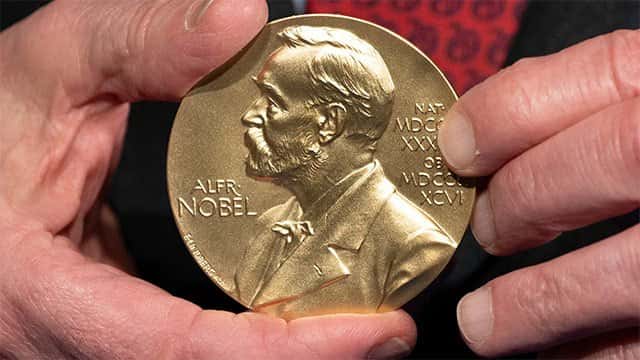








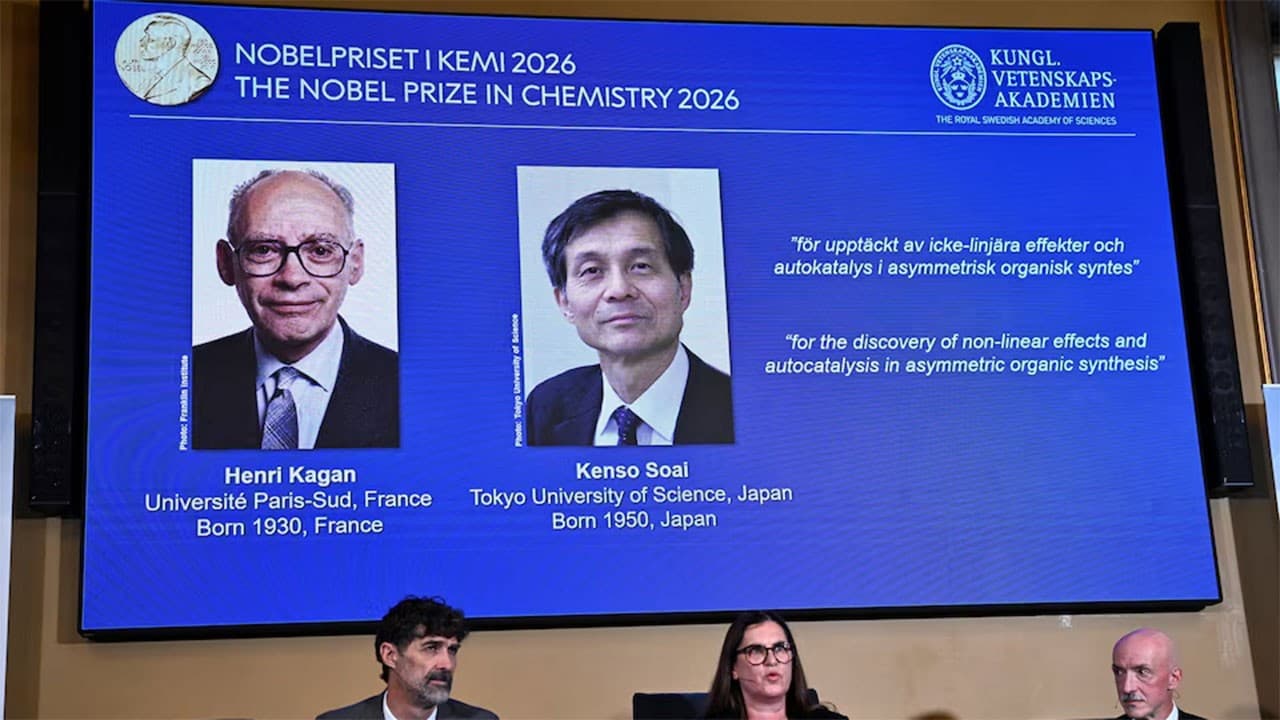



France's Henri Kagan and Japan's Kenso Soai on Wednesday won the Nobel Prize in Chemistry for research into molecules' mirror images, decisive for the development of pharmaceuticals.
The researchers were honoured "for the discovery of non-linear effects and autocatalysis in asymmetric organic synthesis", the jury said.
“Henri Kagan and Kenso Soai have provided a solution to a chemical mystery that is over a century old: how homochirality can emerge spontaneously,” Heiner Linke, chair of the Nobel Committee for Chemistry, said in a news release. “The chemical reactions they have developed are spectacular.”
Kagan is affiliated with Université Paris-Sud in Orsay, France, and Soai, 95, with the Tokyo University of Science.
The Royal Swedish Academy of Sciences announced the winner in Stockholm.
Last year, three scientists won the Nobel Prize in chemistry for their development of new molecular structures that can trap vast quantities of gas inside, laying the groundwork to potentially suck greenhouse gases out of the atmosphere or harvest moisture from desert environments.
This year's prizes began with the Nobel for medicine, awarded Monday to three scientists whose work led to a tool that uses light to help unravel how the brain works. The physics award Tuesday recognised a scientist's efforts to demystify a rare group of neutrinos.
The literature prize is set to be awarded Thursday. After Friday’s peace prize is awarded, the Nobel Memorial Prize in Economic Sciences will be announced Monday.
The prize money this year is 12 million Swedish kronor (about $1.2 million), whether for an individual, a small group of laureates or an organisation.
-Agencies