





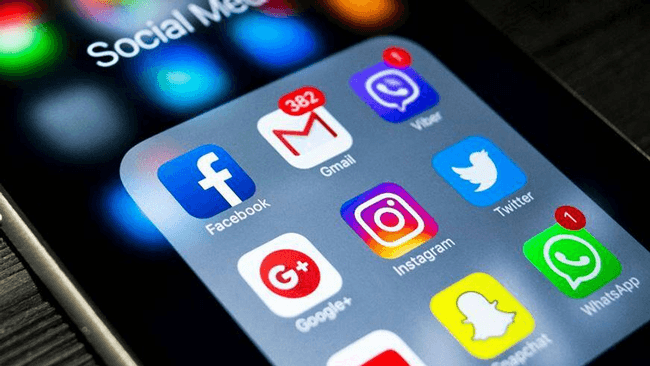


A debate around banning social media for children under 16 is gathering momentum in India, with ministers in several states saying they are studying a law that recently came into effect in Australia.
Ministers in at least two southern states have said recently that they are checking if a ban would be effective in keeping children away from social media.
And last week, the Economic Survey - an annual document written by a team led by India’s chief economic adviser - recommended that the federal government consider age-based limits for social media use by children. The survey’s recommendations are not binding on the government but can inform policy decisions.
Experts, however, warn that such a ban would not be easy in India and could face legal challenges.
Australia recently became the first country in the world to ban most social media platforms for children under 16, making it mandatory for platforms to verify users’ ages and disable accounts by underage users.
The move sparked criticism from social media platforms which, Australia’s internet regulator told the BBC last month, came to the regime “kicking and screaming - very very reluctantly”.
Last week, lawmakers in France’s lower house approved a bill that would ban social media access for under-15s. It still needs to be passed by the Senate.
The UK is also considering a ban.
In India, LSK Devarayalu, a lawmaker from the regional Telugu Desam Party - which governs Andhra Pradesh state and is a key part of Prime Minister Narendra Modi’s federal coalition - proposed a bill last week seeking to bar children under 16 from using social media.
As a private member’s bill, the proposal does not reflect government policy and is unlikely to become law - but it could shape parliamentary debates.
Separately, the Andhra Pradesh government has set up a group of ministers to study global regulatory frameworks and invited major platforms, including Meta, X, Google and ShareChat, for consultations. The companies haven’t commented on the invitation yet.
The state’s Information Technology Minister Nara Lokesh last week said on X that children were “slipping into relentless usage” of social media, affecting their attention spans and education.
“We will ensure social media becomes a safer space and reduce its damaging impact - especially for women and children,” he added.
Other states have expressed interest in similar measures.
Goa’s Tourism and IT Minister Rohan Khaunte said the state was examining whether a ban could be implemented, adding that more details would follow.
Priyank Kharge, the IT minister of Karnataka - home to Bengaluru city which is known as India’s Silicon Valley - told the state assembly that the government was discussing responsible use of artificial intelligence and social media, and referred to a “digital detox” programme involving around 300,000 students and 100,000 teachers that the government launched in partnership with Meta.
Kharge, however, did not specify whether legislation was being considered or which age groups might be affected.
But enforcing state-level bans would be complicated, says digital rights activist Nikhil Pahwa. “While companies can infer users’ locations through IP addresses, such systems are often inaccurate. Where state boundaries are very close, you can end up creating conflicts if one state bans social media use and another does not.”
He also points to difficulties around age verification, saying the issue was not unique to India. “Age verification is not simple. To adhere to such bans, companies would effectively have to verify every individual using every service on the internet,” Pahwa told the BBC.
Even in Australia, some children have told the BBC that they get around the ban by using fake birthdays to create new accounts.
According to Prateek Waghre, a public policy expert and head of programmes at the Tech Global Institute, enforcement would also depend on the cooperation of platforms and intermediaries.
“In theory, location can be inferred through IP addresses by internet service providers or technology companies, but whether the companies operating such apps would comply, or challenge such directions in court, is not yet clear,” he says.
While lawmakers have identified a genuine problem, a ban seems to be an overly narrow response, experts think.
A recent study by a non-profit organisation that surveyed 1,277 Indian teenagers suggests that age-based restrictions and verification systems may face additional hurdles in India’s digital landscape.
Many accounts, it says, are created with help from family members or friends and are not linked to personal email addresses, complicating assumptions of individual ownership that underpin age-verification systems.
While some parents in India have welcomed the idea of a ban online, others point out a deeper issue.
“Parents themselves fail to give enough time to children and hand them phones to keep them engaged - the problem starts there,” says Delhi resident Jitender Yadav, who has two daughters aged eight and four.
“I am not sure if a social media ban will help. Because unless parents give enough time to their children or learn to keep them creatively engaged, they will always find ways to bypass such bans,” he says.
Source: BBC
--Agencies