




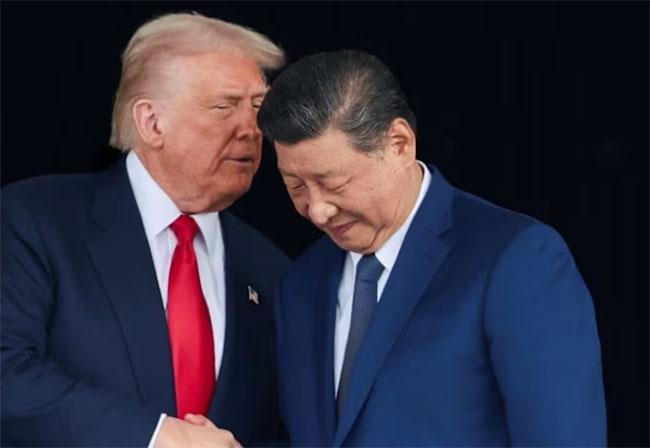



Beijing has confirmed that US President Donald Trump will travel to China this week to meet Xi Jinping.
The visit, from 13-15 May, will be the first to China by a US president in nearly a decade - and comes at a pivotal moment for ties between the world’s two largest economies.
Executives from some of America’s biggest companies - including Boeing, Citigroup and Qualcomm - are expected to travel with Trump, potentially to make deals with Chinese firms. It will also mark a key test in the fragile trade truce between Washington and Beijing.
In April 2025, Trump unveiled sweeping import taxes on countries across the world, friend or foe.
A major effect of that policy was a tit-for-tat trade war between the US and China that saw them hit each other with tariffs that topped 100%. The tariffs were paused after Trump and Xi’s last face-to-face meeting in South Korea in October. But threats from both sides have continued.
With so much at stake, here’s how we got here.
How the trade war started
Trump won the 2016 election vowing to make trade fairer for the US and to bring manufacturing jobs back to the country.
In 2018, he announced tariffs on $250bn (£185bn) of Chinese imports - the moment that many analysts say the trade war started.
The same year, Trump imposed levies on other trading partners - including Mexico, Canada and Europe - which he said were also taking advantage of the US.
The sweeping measures were a shock, especially for China, said policy researcher Ning Leng from Georgetown University.
“It was the first time they dealt with Trump seriously, and they probably did not expect him to go ahead with it,” Leng said.
At the time, China was much more reliant on trade with America.
The US was a key importer of Chinese manufactured goods, putting its workers at risk if American buyers turned away due to Trump’s tariffs.
The tensions added to existing issues that have weighed on China’s economy for years, including sluggish domestic consumption, high unemployment and a prolonged property crisis.
Exports to the US offered a lifeline for Chinese jobs, but with Trump, that was now put at risk.
“It’s harder for one country to withstand a trade war with another that it has a trade surplus with,” Leng said.
When Joe Biden succeeded Trump in 2021 he kept up the pressure on Beijing.
His administration chose not to lift Trump’s tariffs on China, sharing a belief that the US needed to keep a lid on its rival’s growth in sectors like technology, Leng said.
Biden also introduced restrictions on Chinese firms, including tech giant Huawei, which was essentially ousted from the US over national security concerns. He also put TikTok under scrutiny, with its US operation eventually being separated from its Chinese parent company.
Chinese electric vehicles (EVs) were also effectively blocked from the US market after heavy tariffs were imposed by Biden.
“We often think that Trump is tough on China, but there is an argument to say that Biden was even more protectionist than Trump was,” said economist Tang Heiwai from the University of Hong Kong.
Trump 2.0
Trump doubled down on his tariff policies after returning to office in 2025.
He imposed 20% tariffs on China, accusing it of allowing the influx of the drug fentanyl into the US. On Trump’s so-called Liberation Day, he set a 34% levy on Chinese goods, making the total tariffs on China among the highest of any country.
The tariffs shook Chinese businesses and led to goods piling up in warehouses, while US firms scrambled to find alternative supplies.
Beijing quickly retaliated with its own measures, including duties on US agricultural goods, hitting farmers - a key Trump voter base.
But Trump doesn’t appear to have accounted for China’s near-monopoly of the world’s supplies of rare earths - crucial for making everything from smartphones to fighter jets.
Trump had used tariffs to force countries to make deals favourable to the US. But he couldn’t risk key businesses that rely on China’s raw materials. It was time to bargain.
A meeting between Trump and Xi in October ended with Beijing suspending those export controls, marking a win for Trump. He also said he got China to start immediately buying US agricultural goods and other farm products - a backbone of the American economy.
In return, Washington dropped part of the tariffs it had imposed on China over the flow of ingredients used to make the synthetic opioid fentanyl.
Planned increases to reciprocal tariffs were also paused and in the weeks after the meeting restrictions over the sale of advanced semiconductors to China were lifted, although this did not apply to the most cutting-edge chips.
What’s on the agenda this time?
While a tariffs truce was agreed last year, a permanent resolution to the dispute has so far remained elusive.
China’s heavy investment in manufacturing means its businesses have little choice but to sell abroad as spending at home remains weak, Tang said.
“It will need the US. There’s no single country as big as them as a consumer market,” Tang said.
That said, Beijing is going into this meeting from a position of strength.
China’s export figures have hit record levels - a result of making new trading partners around the world as ties with the US weakened.
Beijing also continued to invest heavily in robotics, alongside efforts to make its own advanced chips and cut its reliance on Western firms like Nvidia.
On its part, the Trump administration is likely to push Beijing to make more purchases of goods from vital US industries, including soybeans and aircraft parts.
But the visit also comes as Trump is dealing with a setback to his trade policies after the US Supreme Court struck down his Liberation Day tariffs.
He turned to a separate law to impose a temporary 10% levy on all countries in the meantime, while launching an investigation into China and other countries over unfair trade practices.
And just last week, a US trade court ruled that the latest global tariffs were not justified, which could lead to future court challenges.
What about Iran?
There is little doubt that the Iran war will loom large over the Trump-Xi meeting.
With its vast oil reserves and diversified energy sources, China has so far appeared to weather the fallout of the war better than many of its neighbours.
China is a major oil producer, while most of its imported crude comes from Russia. These factors have helped cushion the impact of the conflict, despite Beijing being Iran’s biggest buyer of oil.
Still, there are signs that as the war drags on it is testing the Chinese economy, with senior officials pledging strong measures to protect China’s energy security and supply chains, policy analyst Lyle Morris said.
And so while both Beijing and Washington might be incentivised to bring an end to the conflict - both sides have major differences in their views on Iran - and the world will be watching how, and if, they manage to overcome this.
Source: BBC
-- Agencies