




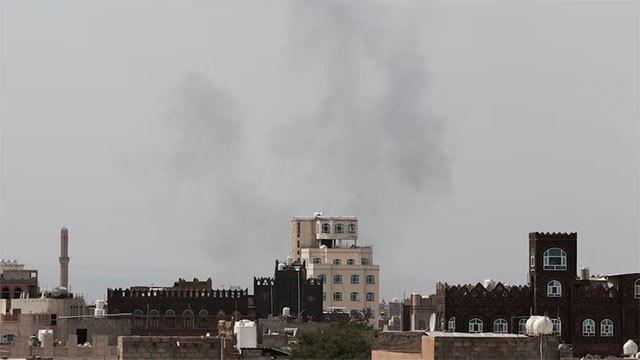



The Houthi movement that controls northern Yemen accused Saudi Arabia on Monday of launching airstrikes against the international airport in Sanaa, and vowed to retaliate, testing a truce in the long-running conflict between the kingdom and the Iran-aligned group.
Houthi military spokesperson Yahya Saree called the attacks "blatant aggression" and said they had ended a period of de-escalation. He said regional power Saudi Arabia would bear the consequences and that the attack would not go unanswered.
The Saudi government's communication office did not immediately respond to the accusations.
The general aviation authority of Yemen's Saudi-backed, internationally recognised government ordered the closure of all airports nationwide, before announcing hours later that they had reopened.
Earlier on Monday, the government's defence ministry said the runway at Sanaa International Airport had been targeted to prevent an Iranian plane from landing. An armed forces spokesman later said the aircraft had landed at Houthi-controlled Hodeidah airport.
It was unclear whether any attempt had been made to stop it from landing in Hodeidah, about 150 km (93 miles) southwest of Sanaa, on Yemen's Red Sea coast. Another minister said the Houthis were detaining another plane, belonging to the International Committee of the Red Cross, at Sanaa airport.
The government, which operates from the southern port of Aden, has the support of Saudi Arabia and other Gulf states.
REGIONAL RISK
In addition to straining a ceasefire in the conflict, Monday's violence may upset broader efforts to defuse conflict in the region linked to the Iran war, given the Houthis are aligned with Tehran.
Saudi Arabia has remained relatively isolated from the Iran conflict and has not faced the same degree of Iranian attacks as other Gulf states. A return to conflict between the Houthis and Saudi Arabia could change that.
Yemen has faced civil war and proxy warfare from outside powers for more than a decade, since the Houthis seized the capital and forced the internationally recognised government to relocate to the south. Years of fighting in Yemen after a Saudi-led coalition intervened in 2015 against the Houthis triggered one of the world’s worst humanitarian crises. Violence flared again late last year after a separatist movement backed by the United Arab Emirates swept through territory in the south, splintering the Saudi-led coalition created to fight the Houthis.
Still, a 2022 truce has largely held, despite regional escalation tied to the Israel-Gaza war that saw the Houthis fire on Red Sea shipping, as well as the Iran conflict.
ICRC PLANE HELD
Moammar bin Mutahar Al-Eryan, the information minister in the internationally recognised government, said the Houthis were detaining an aircraft belonging to the International Committee of the Red Cross at Sanaa airport and holding its pilot and co-pilot.
Hachem Osseiran, ICRC spokesperson for the Middle East, told Reuters all ICRC staff and the crew of the plane were safe and accounted for, declining to comment further. It was unclear whether the incidents involving the two planes were directly linked.
In recent days an ICRC-mediated prisoner exchange deal between the Houthis and Yemen's internationally recognised government fell through, with both sides exchanging blame in a sign of growing tension.
Earlier on Monday, the government's defence minister had said it had exhausted diplomatic efforts to persuade Iran and the Houthis to stop what he described as Iranian aircraft violating Yemeni airspace.
He said government forces would respond to any hostile aircraft violating Yemen's airspace "by all available means", and held Iran responsible.
Source: Reuters
– Agencies