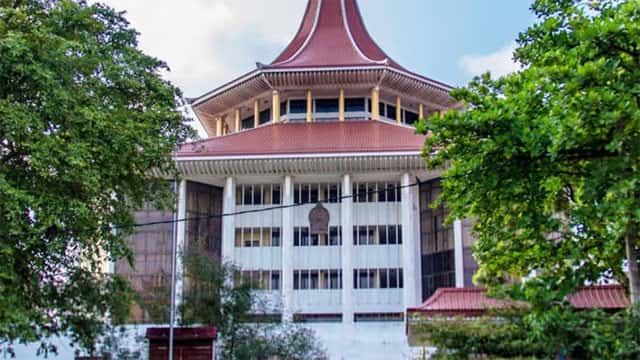










Two more petitions have been filed before the Supreme Court today (18), challenging the constitutionality of the proposed 22nd Amendment to the Constitution and seeking a determination that it must receive approval at a referendum if Parliament proceeds with the legislation.
The Free Lawyers Organization filed one of the petitions, with its President, Attorney-at-Law Maithri Gunaratne, seeking a determination that the proposed amendment is inconsistent with the Constitution.
The petition further requests the Supreme Court to rule that the Bill, if enacted, must be passed by a two-thirds majority in Parliament and subsequently approved by the people at a referendum.
Meanwhile, former Law Professor and former Parliamentarian Prof. G.L. Peiris has separately petitioned the Supreme Court, specifically challenging the provision seeking to extend the retirement age of judges of the Supreme Court and Court of Appeal.
Filed under Articles 120 and 121 of the Constitution, Prof. Peiris’ petition names the Attorney General as the respondent.
He has challenged Clause 2 of the proposed amendment, which seeks to amend Article 107 of the Constitution by increasing the retirement age of Supreme Court judges from 65 to 67 years and that of Court of Appeal judges from 63 to 65 years.
According to the petition, the proposed provision would apply to incumbent judges, including the sitting Chief Justice.
Prof. Peiris argues that applying the amendment to serving judges could undermine judicial independence, separation of powers and public confidence in the judiciary.
He contends that Clause 2 is inconsistent with or violates several provisions of the Constitution, including Articles 3, 4, 12(1), 28, 107, 108, 111C and 83.
The former law professor has also cited previous Supreme Court determinations concerning judicial independence and the retirement age of judges, arguing that constitutional safeguards relating to the security of judicial tenure cannot be altered without the consent of the people at a referendum.
Prof. Peiris has therefore asked the Supreme Court to determine that Clause 2 can become law only if it is approved by a two-thirds majority of the whole number of Members of Parliament, including those not present, and subsequently endorsed by the people at a referendum.
He has also requested that the matter be heard by a Full Bench comprising all sitting judges of the Supreme Court, citing the exceptional constitutional importance of the case and its implications for judicial independence.
The two petitions come after the proposed 22nd Amendment was presented to Parliament today (18), following its approval by the Cabinet of Ministers.