






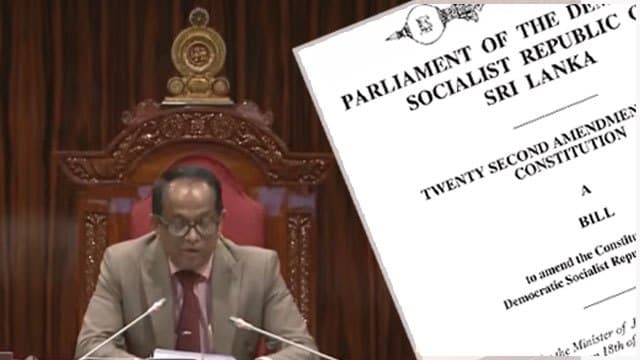


Update - The Third Reading of the Twenty-Second Amendment to the Constitution Bill, which seeks to raise the retirement age of judges, has been passed with amendments with a special majority in the Parliament.
A total of 158 members voted in favour of the constitutional amendment while 63 voted against it. There were no abstentions during the Third Reading division of the bill.
The bill will thereby come into effect as the Twenty-Second Amendment to the Constitution Act after the Speaker of Parliament endorses his certificate on the bill.
Earlier, the Second Reading of the Twenty-Second Amendment to the Constitution Bill was passed in the Parliament, with a special majority.
A total of 158 Members of Parliament (MPs) voted in favor, while 63 voted against, with no abstentions.
The vote was concluded a short while ago, following a two-day debate on the proposed constitutional amendment. Accordingly, the Bill was passed with a majority of 95 votes.
The Twenty-Second Amendment to the Constitution Bill and the Judicature (Amendment) Bill were presented to Parliament on August 18 by Minister of Justice and National Integration Harshana Nanayakkara.
The Twenty-Second Amendment to the Constitution Bill includes provisions to amend the retirement ages of Supreme Court and Court of Appeal judges, among other amendments.
The proposed constitutional amendment seeks to raise the mandatory retirement age of Supreme Court judges from 65 to 67, while increasing the retirement age of Court of Appeal judges from 63 to 65.
It also proposes that the Chief Justice retire upon reaching the age of 67 or upon completing six years in office, whichever occurs earlier.
The parliamentary debate on the Twenty-Second Amendment to the Constitution Bill commenced yesterday (24).
The vote followed the presentation of the Supreme Court’s determination on the proposed amendment, which was informed to the Parliament last Tuesday (22) by Speaker Dr. Jagath Wickramaratne.
The Supreme Court determined that a referendum is not required for the passage of the Twenty-Second Amendment to the Constitution Bill and that it may be passed by a special two-thirds majority in Parliament.
Speaker Dr. Jagath Wickramaratne also informed Parliament that the Supreme Court had determined that the Judicature (Amendment) Bill could be passed by a simple majority.
The government has said the proposed changes are intended to strengthen the judicial system, improve efficiency and address delays and the backlog of cases. The Cabinet of Ministers had earlier approved drafting of the legislation with the stated objective of strengthening judicial independence and facilitating the efficient disposal of pending cases.
The Bills faced legal challenges after being presented to Parliament. More than 65 petitions were filed before the Supreme Court challenging the legislation. The petitions were taken up before a five-member bench headed by the Chief Justice on September 1, and the hearing concluded on September 2.
Following the hearings, the Supreme Court communicated its determination to the Speaker, who subsequently announced it in Parliament on September 22, 2026.
The proposed amendments have drawn criticism from the Bar Association of Sri Lanka (BASL) and opposition parties, who have raised concerns over the potential impact of extending judicial tenure on judicial independence and the constitutional system.