











Following discussions with officials of the Central Bank of Sri Lanka (CBSL) regarding Foreign Exchange Regulations Nos. 01 and 02 of 2026 and the Order issued under Section 22 of the Foreign Exchange Act, the Committee on Public Finance (COPF) has approved the said Regulations and Order.
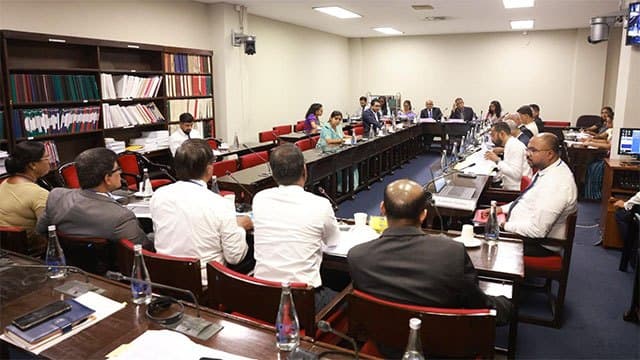
The matter was considered at a meeting of the Committee on Public Finance held in Parliament recently under the chairmanship of Member of Parliament Dr. Harsha de Silva, the Communication Department of Parliament said.
The Committee examined the relevant provisions relating to foreign investments, the transfer of funds overseas by emigrants, and measures to control foreign exchange outflows from the country.
Deputy Ministers Chathuranga Abeysinghe and Nishantha Jayawera, as well as Members of Parliament Ravi Karunanayake, Ajith Agalakada, Nimal Palihena, Wijesiri Basnayake, Thilina Samarakoon, Champika Hettiarachchi and Attorney-at-Law Lakmali Hemachandra, participated in the meeting.
Officials representing the Ministry of Finance, Sri Lanka Customs, the Department of Trade and Investment Policy, the Department of Import and Export Control, the Central Bank of Sri Lanka and its Department of Foreign Exchange also participated in the meeting.
The Committee focused on the provisions relating to investments made overseas by persons resident in Sri Lanka under Foreign Exchange Regulations No. 01 of 2026. Discussions were held on persons eligible to make foreign investments, the sectors in which investments may be made, and the applicable restrictions on transferring capital overseas, the statement said.
Attention was also given to the opportunities available for Sri Lankan companies to expand their business operations overseas and the financial facilities required for such expansion.
With regard to Foreign Exchange Regulations No. 02 of 2026, discussions were held on the procedures and restrictions applicable to emigrants transferring assets held in Sri Lanka overseas. In particular, the Committee was briefed on the existing provisions relating to the transfer of capital overseas under the Emigrant’s Allowance, as well as the remittance overseas of current income such as rental income, interest and dividends, it stated.
Meanwhile, the Committee also discussed the Order issued under Section 22 of the Foreign Exchange Act. Officials of the Central Bank explained the temporary restrictions currently in place to manage foreign exchange outflows, taking into consideration the prevailing economic conditions and the need to safeguard foreign exchange reserves.
The officials further informed the Committee that consideration is also being given to gradually relaxing these restrictions as economic conditions improve, the statement said.
The Committee also discussed the export earnings brought into the country by exporters during the previous year and the opportunities available to use a portion of those earnings for the expansion of businesses overseas.
The importance of providing facilities required by local businesses to expand their operations in international markets was also highlighted, the statement said.
The Committee further focused on investigations into the unauthorised outflow of foreign exchange from the country and the monitoring mechanisms in place in this regard. Measures taken to minimize discrepancies between banking and Customs data relating to imports and exports were discussed, along with the need to strengthen coordination among relevant institutions to prevent the misuse of foreign exchange.
In addition, the Committee considered the restrictions on bank guarantees and other financial facilities required by local companies, including construction companies, when seeking business opportunities overseas, it stated.
During the discussion, Committee members also pointed out that imposing unnecessary regulations could discourage businesses and create a risk of hindering economic growth. Expressing his views, the Chairman pointed out that restricting foreign exchange outflows could also result in a reduction in the amount of foreign exchange flowing into the country.
According to the statement, the Chairman also questioned why the amount specified in the Regulations as USD 2 million had been stated as USD 0.75 million in the Order in relation to the expansion of listed companies.
In response, officials of the Department of Foreign Exchange stated that the USD 0.75 million limit would apply only for a period of approximately six months, and that consideration would be given to relaxing the limit in 2027. They further stated that the corresponding limit for non-listed companies is USD 0.2 million.
The Department of Foreign Exchange stated that foreign exchange exceeding these limits may be converted with the approval of the Monetary Board of the Central Bank of Sri Lanka. It was also explained that such approval would be granted based on the balance sheet of the business, the statement added.
However, views were also expressed that businesses with higher asset levels may have greater opportunities to obtain such approval.