










The government has stepped up efforts to strengthen its response to emerging cyber scam operations and the trafficking of persons for forced criminality, with the National Anti-Human Trafficking Task Force (NAHTTF) and the International Organization for Migration (IOM) convening a development partners’ briefing in Colombo.
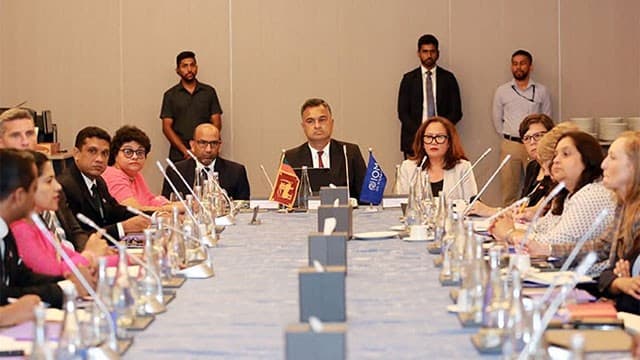
The briefing, titled “Emerging Cyber Scam Operations in Sri Lanka and Trafficking in Persons for Forced Criminality,” brought together senior government officials, representatives of diplomatic missions and development partners to discuss regional trends, potential risks to Sri Lanka and measures to strengthen early and coordinated responses, the Ministry of Defence said in a statement.
The Secretary to the Ministry of Defence and NAHTTF Chairman Air Vice Marshal Sampath Thuyacontha (Retd) attended the programme, along with representatives from the Ministry of Foreign Affairs, Ministry of Justice, Department of Immigration and Emigration, Computer Crime Investigation Division and the NAHTTF Coordinating Committee.
Representatives of the Australian, Canadian, New Zealand and British High Commissions, the Embassy of Japan, the Embassy of the United States and the European Union, among other development partners, also participated.
IOM Chief of Mission Kristin Parco, Head of the Protection Unit Minoli P. Don and other IOM officials represented the organisation at the briefing.
Discussions focused on the emergence and adaptation of transnational cyber scam networks and their links to trafficking in persons for forced criminality. According to IOM, individuals can be deceptively recruited through purported employment opportunities, transported across borders and subsequently subjected to coercion, threats, debt bondage, confinement and other forms of exploitation, forcing them to participate in cyber-enabled criminal activities.
The briefing highlighted the need for early identification of trafficking indicators and stronger systems for victim referral, protection and assistance, the Defence Ministry noted.
IOM Chief of Mission Kristin Parco also stressed the importance of specialised technical capacity to identify and respond to trafficking linked to cyber scam operations, while contributing to discussions on strengthening regional cooperation.
The NAHTTF outlined Sri Lanka’s priorities under a four-pillar approach encompassing prevention, protection, prosecution and partnership.
The task force identified public awareness, victim identification and referral mechanisms, digital and financial investigation capabilities, intelligence and information sharing, and cooperation among government agencies, law enforcement authorities, international organisations, the private sector and regional partners as key areas requiring further attention.
Particular emphasis was placed on screening people encountered in connection with cyber scam operations, including foreign nationals, for possible indicators of trafficking. Authorities also stressed that individuals identified as potential trafficking victims should receive appropriate referral, protection and assistance.
The briefing forms part of Sri Lanka’s ongoing efforts to strengthen national preparedness in response to emerging regional risks associated with cyber-enabled crime and trafficking.
It also provided an opportunity for the government and development partners to explore technical cooperation, capacity building, information sharing and cross-border collaboration.
The discussions reaffirmed the importance of early identification of trafficking victims and a coordinated, protection-centred response, alongside measures to prevent, detect and investigate cyber-enabled crime and trafficking for forced criminality, according to the Defence Ministry.