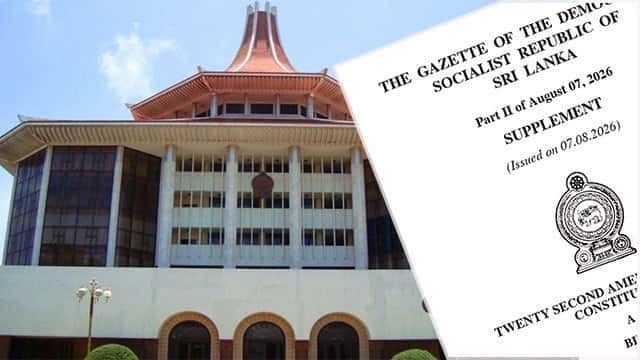












The Supreme Court today (01) rejected a request to appoint a full bench of Supreme Court justices to hear petitions challenging the 22nd Constitutional Amendment Bill.
The decision was delivered by a five-member bench headed by Chief Justice Preethi Padman Surasena, as the court commenced hearing 67 petitions filed against the proposed 22nd constitutional amendment.
After considering submissions from the parties, the bench ruled that the petitions would continue to be heard by the existing five-judge bench.
The 22nd Constitutional Amendment Bill, which proposes changes relating to the retirement age of judges of the superior courts, was presented to Parliament for its first reading on August 18, one week after it was gazetted.
A two-week period was subsequently provided for parties to challenge the constitutionality of the Bill before the Supreme Court. That period ended yesterday, with 67 petitions filed against the proposed amendment. Of these, 41 petitions were filed online.
Meanwhile, five petitions have also been filed challenging the Judicature (Amendment) Bill currently before Parliament.
The Supreme Court yesterday issued notice to the Attorney General requesting submissions in relation to the petitions.
Request for a Full Bench
When the hearing commenced this morning, President's Counsel M.A. Sumanthiran, appearing for the Bar Association of Sri Lanka (BASL), requested that the petitions be heard before a full bench comprising all justices of the Supreme Court.
Sumanthiran argued that the proposed legislation directly affects the independence of the judiciary, as it would extend the term of the Chief Justice by two years and increase the retirement age of other judges.
He submitted that this created a potential conflict of interest for judges hearing the petitions.
“Therefore, a conflict of interest arises at this point. In view of this situation, I request that the petitions relating to this Bill be heard before a full bench comprising all the judges of the Supreme Court,” he told the court.
President's Counsel Saliya Peiris, Ali Sabry, Jeffrey Alagaratnam, Eraj Silva, Srinath Perera, Anura Meddegoda and Maithri Gunaratne, among others, also made submissions supporting the request on behalf of other petitioners.
However, Solicitor General Viraj Dayaratne, appearing for the Attorney General, submitted that the discretion to appoint a Supreme Court bench rests with the Chief Justice.
After considering the submissions, the five-judge bench rejected the request for a full bench and ordered that the petitions continue to be heard by the existing bench.
Bar Association Raises Constitutional Concerns
Following the ruling on the bench, President's Counsel M.A. Sumanthiran made further submissions on behalf of the Bar Association of Sri Lanka.
He argued that the proposed amendment would violate several provisions of the Constitution, particularly Article 3, which relates to the sovereignty of the people.
He submitted that Articles 3 and 4 are directly connected to popular sovereignty and argued that changes affecting Article 4 could consequently affect Article 3.
According to Sumanthiran, amendments affecting these constitutional provisions should therefore be referred to the people at a referendum.
He also referred to a 2022 Supreme Court determination concerning the Inland Revenue Bill, which he said had held that a referendum was necessary to extend the retirement age of judges.
Sumanthiran said the Bar Association had previously raised concerns about the proposed amendment with the relevant authorities but had not received a response.
He further noted that six judges had retired since the current government came to power, including two Chief Justices.
“If this amendment is passed, the independence of the judiciary will be violated,” he told the court.
Ali Sabry Warns of Impact on Judicial Independence
President's Counsel Ali Sabry, appearing on behalf of former minister Professor G.L. Peiris, also argued that judges must be able to perform their duties in an environment free from interference.
Sabry said a parliamentary two-thirds majority should not be used to undermine judicial independence.
“I regret having to make such submissions before this court. We have been compelled to make these submissions in order to protect the independence of the judiciary and to protect the dignity of Your Lordships,” he said.
He argued that judicial independence could be affected not only by reducing the retirement age of judges, but also by increasing it.
“The Executive should not place Your Lordships in this kind of difficult position,” Sabry said.
He also stated that Sri Lanka, as one of the oldest states in South Asia, should not move towards systems of governance such as those in China or Vietnam.
Petitioners Question Judges Hearing Their Own Case
President's Counsel Srinath Perera, appearing for another group of petitioners, raised a further legal objection concerning the composition of the bench.
He referred to the principle that a judge should not adjudicate a matter in which the judge has a personal interest.
“Since this Bill affects the judges of this court, it is not appropriate for Your Lordships to consider these petitions,” Perera submitted.
He argued that if the judges themselves could not hear the matter due to a potential conflict of interest, the alternative would be to refer the issue to a referendum.
The Supreme Court is continuing to consider the petitions challenging the 22nd Constitutional Amendment Bill.