








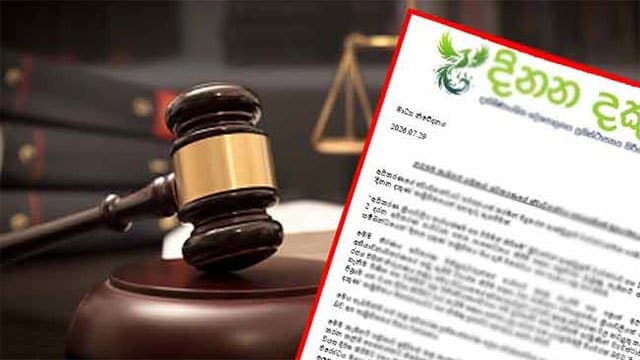



The “Dinana Dakuna” collective has voiced strong opposition and concern over the Cabinet approval recently granted to amend the Constitution and the Judicature Act No. 2 of 1978, under the stated objective of “making the judicial process more efficient and streamlined.”
In a special statement, the collective claimed that the proposed amendments could mark the beginning of an erosion of judicial independence.
The group said that while the government has presented the move as an administrative measure aimed at increasing the number of judges and expanding Court of Appeal hearings at the provincial level, it believes the proposal could instead serve political interests.
According to the collective, the amendments could pave the way for extending the constitutionally stipulated retirement age of senior judges, including the possibility of retaining the current Chief Justice in office.
The group alleged that the proposed reforms were a political strategy presented under the appearance of judicial reform, aimed at avoiding previous criticism from lawyers and civil society over attempts to extend the retirement age of Supreme Court and Court of Appeal judges.
The statement claimed that proposals to increase the number of High Court judges and establish provincial-level Court of Appeal sittings were being used to package the retirement age extension proposal within a broader judicial reform programme.
“Expanding the judiciary and reducing delays in cases are administrative matters and do not require changes to the terms of office of Supreme Court judges, including the Chief Justice,” the collective stated.
It further argued that linking judicial expansion measures with changes to judges’ retirement provisions could create a precedent for political interference in the judiciary.
The collective warned that altering constitutional provisions for the benefit of serving officeholders could undermine the separation of powers and the system of checks and balances.
It said that if an Executive government changes legally established terms of office while an individual is holding that position, it could increase the risk of institutional dependence and weaken judicial independence.
The collective challenged the government to clarify whether the proposed amendments were introduced due to genuine administrative requirements or political considerations.
It said that if the objective was only to retain the experience of senior judges within the judicial system, any increase in retirement age should apply only to judges appointed in the future.
The group warned that granting immediate extensions to serving judges, particularly the sitting Chief Justice, would indicate that the move was intended to achieve political objectives rather than introduce long-term judicial reforms.
The “Dinana Dakuna” collective called on the public, the Bar Association of Sri Lanka (BASL), civil society organizations, trade unions and Members of Parliament to closely examine the draft legislation expected to be prepared by the Legal Draftsman.
The collective urged citizens to remain vigilant against any attempts to weaken constitutional safeguards in the name of improving judicial efficiency, emphasizing that judicial independence is a fundamental protection against the misuse of state power.